The AfCFTA, national interests and regional value chains


While the African Continental Free Trade Area (AfCFTA) is increasingly seen as a vehicle for industrialisation through regional value chains, local value addition is still pursued largely through national measures, from mineral export bans to import restrictions. Mohammed El Maziani Haddouchi and Bruce Byiers explore the challenges of bridging regional ambitions and national priorities.
The AU’s mid-year coordination meeting in October 2026 stressed that a continental free trade area alone will not be enough for Africa’s economic transformation, and that it must be “accompanied by increased productive and manufacturing capacity”.
This reflects a longstanding continental goal. The 1980 Lagos Plan of Action flagged Africa’s low share of value addition to its natural resources and put regional industrialisation and trade at the centre of the continent’s integration ambitions. Yet, over four decades later, primary goods still accounted for 76.7% of African merchandise exports in 2025, with only a few large exporters having achieved some degree of industrialisation.
Why open markets are not enough
Regional integration across the continent has largely followed a linear and market-led path, through free trade areas and customs unions, based on the assumption that lower trade costs will stimulate investment and industrialisation. Yet for industrial goods, production capabilities matter at least as much as market access, particularly in countries exporting similar primary commodities.
Countries cannot trade regionally what they cannot produce and have little reason to buy from neighbours what they make themselves. Regional integration should therefore not only open markets but also help build the productive capacities (such as know-how, infrastructure and access to finance) that allow domestic enterprises to operate across borders in selected value chains.
The AfCFTA explicitly aims to promote industrial development through regional value chains, but, despite some industrial policy provisions, lacks the tools to build the productive capacities and firm-level connections that value chains require. At the AU summit in February 2026, heads of state therefore directed the Council of Ministers to negotiate an industrial policy and development protocol, and requested AU development agency AUDA-NEPAD to finalise a continental industrialisation programme to help member states design and monitor industrial policies aligned with the AfCFTA.
These efforts build on multiple regional industrialisation strategies adopted by regional economic communities (RECs). Yet, industrial value chains remain fragmented, owing to limited access to finance and enabling infrastructure, a lack of aligned regional policies, and duplication and competition between isolated national strategies.
Much of the recent drive for value addition is pursued at the national level, through export bans, local processing requirements and import restrictions. How to bridge regional ambitions and national priorities to develop regional value chains therefore remains a central question.
Regional promise, national routes
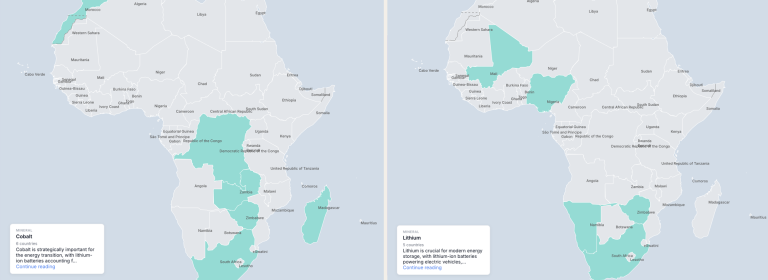
This question is particularly relevant for critical minerals, which mineral-rich governments see as an opportunity to industrialise through local value addition. Africa is estimated to hold 30% of global reserves of minerals critical for the energy transition.
As our interactive map shows, these are spread across the continent, and particularly concentrated in Southern Africa. Mining contributes more than 10% of the Southern African Development Community (SADC)’s GDP, 25% of its total exports and around 20% of government revenues. Such commodity dependence varies across countries and exposes public finances and exchange reserves to price swings, strengthening the case for value addition.
In its 2020-2030 strategy, SADC prioritised regional value chains and value addition in minerals, alongside agro-processing and pharmaceuticals, and its August summit heard calls to accelerate mineral beneficiation and regional value chains through the AfCFTA.
But how can such regional ambitions materialise when countries pursue value addition through national routes? Zimbabwe banned raw lithium ore exports in 2022, and saw its first lithium processing plant inaugurated in July 2026. In February 2026, it halted lithium concentrate exports, before relaxing the measure in April, with a full ban now due in 2027. The Democratic Republic of the Congo (DRC) has repeatedly used quotas and recently banned exports of copper and cobalt concentrates, while Mozambique prohibits exports of raw or semi-processed minerals unless operators secure ministerial approval backed by a local processing plan.
Joint efforts, by contrast, have proved harder. The DRC-Zambia initiative to develop battery precursors has reportedly faced disagreements over the location of the plant, pointing to a broader question of how industrialisation gains can be distributed when countries seek to cooperate.
Regional value chains remain at an ‘incipient’ stage, and where they exist, trade tends to be one-directional and concentrated around a few hubs. Left to the market, they would likely strengthen a few countries’ existing industrial capacity and distribute benefits unevenly.
Regional value chains, in other words, imply winners and losers. Their sustainability will depend on finding ways to govern how benefits are shared across countries, along the value chain and within firms – even if, as Fiona Tregenna put it, "in a market economy, some people have to get rich through industrialisation for it to be viable”. It will also require long-term planning, coordination and aligned interests between governments and firms, while still allowing for competition between countries.
This applies beyond minerals. Concerns over South Africa’s dominance in agricultural trade have led Botswana and Namibia to repeatedly restrict imports to create space for domestic producers, despite all three being members of SADC, the Southern African Customs Union (SACU) and the AfCFTA. Competing national interests also shaped AfCFTA negotiations on rules of origin for textiles and apparel, which have been settled only provisionally. Such gaps between regional commitments and national practice reflect political incentives and state-business relations.
Building on national ambitions?
Politically, national industrial ambitions have to be the starting point. There are limits to what a single country can achieve on its own, but to work, regional and continental strategies must offer a means for governments to achieve their industrialisation ambitions.
A recent SADC initiative to build sustainable and inclusive mineral value chains, to be implemented in the DRC, Mozambique, Namibia, South Africa, Zambia and Zimbabwe, is driven by the rationale that “no single country in the region possesses all the inputs required to develop complete value chains”.
At continental level, the AU Commission, with the RECs and the AfCFTA Secretariat, has been tasked with developing a continental critical minerals value addition framework that includes local beneficiation and fair benefit-sharing, while the AU’s African Green Minerals Strategy calls for instruments to “level the playing field” for weaker economies, such as local content rules weighted in favour of least developed member states.
Beyond minerals, Côte d’Ivoire, Ghana, Cameroon and Nigeria, which account for 66% of global cocoa production, signed the Abuja Declaration on Cocoa in July 2026 to harmonise standards, expand local processing and bargain collectively with global buyers, while the AfCFTA Advisory Council is working with the private sector to explore ways to build a continental cotton, textiles and apparel value chain.
Making the case for cooperation?
These developments suggest that industrialising through regional value chains will depend on at least two things. The first is building productive capacity, by pooling efforts and investing in infrastructure, energy and know-how, and by making finance available for firms to produce and trade across borders. The second is political, as regional integration makes sense to member states only insofar as it serves their own development goals.
For governments to coordinate their industrial policies, the gains of acting together will need to be clear and outweigh what they expect to achieve on their own, even if those gains, in the short term, are not equally shared. That may be a tall order for the AfCFTA’s future industrial policy and development protocol to address, but it is also an opportunity to help make the connection between national interests and a continental vision.
Mohammed El Maziani Haddouchi is a research assistant working on African economic integration at ECDPM. Bruce Byiers is associate director of sustainable and inclusive economic development at ECDPM.
The AfRI Practice Hub is an initiative by ECDPM with researchers from The Nelson Mandela School of Public Governance at the University of Cape Town. It is funded by the European Union under the Team Europe Technical Assistance Facility to Support the AfCFTA and Continental Economic Integration (EU-TAF).

Views and opinions expressed are those of the authors and do not necessarily reflect those of ECDPM, The Nelson Mandela School of Public Governance or the European Union.