Going meta: Things to agree before negotiating an AfCFTA industrial protocol
In early 2026, the AU Assembly tasked the AfCFTA Council of Ministers with negotiating a new protocol on industrial policy and development. To prevent this initiative from joining the long history of aspirational but weakly implemented African integration policies, Luladay Berhanu Mengistie and Guillaume Gérout Suominen examine how to leverage existing mechanisms and strengthen links with the wider set of AfCFTA instruments.
Summary
In February 2026, the African Union (AU) Assembly instructed the Council of Ministers of the African Continental Free Trade Area (AfCFTA) to negotiate a Protocol on Industrial Policy and Development. This brief aims to inform the drafting process of this important protocol and to help minimise the risk of it becoming another page in the long history of aspirational, but weakly implemented African integration policies. It points to the mechanisms that already exist, underscores that the Protocol will not exist in isolation, and advocates for strengthening the linkages with the wider set of AfCFTA instruments.
We recommend a governance-first approach: governance and coordination mechanisms as the foundation; a catalogue of permitted instruments as the first binding layer; shared principles drawn from existing instruments; and targeted harmonisation implemented gradually, value chain by value chain, with financing and capacity-building as a cross-cutting commitment.
We also recommend that the Secretariat and the Council of Ministers map the industrialisation-related provisions already in the AfCFTA and review the AU Industrialisation agenda, the industrialisation policy framework and the protocols of regional economic communities to identify what the Protocol should build on and where overlaps lie. In addition, they should establish formal coordination with the AU Commission, and determine the Protocol’s legal nature and its relationship with the other AfCFTA instruments. Finally, they should connect the drafting process to the ongoing review of the rules of origin and tariff modalities, and ensure support is in place for members with the least institutional capacity.
Introduction
In February 2026, the African Union (AU) Assembly directed the Council of Ministers of the African Continental Free Trade Area (AfCFTA) to negotiate a Protocol on Industrial Policy and Development. This protocol is intended to be a fundamental component of the AfCFTA legal framework. (1)
The economic rationale for the protocol relates to Africa's weak industrial base, which remains heavily concentrated in a few sectors and countries, and largely disconnected from intra-African trade flows. The protocol therefore seeks to ensure that the market access provided by the AfCFTA spurs productive activity and does not simply increase import penetration. But success will depend on industrial policy effectiveness.
The geopolitical rationale is likewise another imperative. Major economies now compete openly through industrial policy and the use of trade instruments, including subsidies, local-content requirements, rules of origin, and public procurement. (2) Though the line between trade and industrial policy was historically clear, regulatory changes are now eroding it in the very jurisdictions where African exporters are most exposed. Without shared principles on which industrial policy constraints are acceptable, each member state faces this new generation of trade arrangements alone, and risks missing the opportunities for industrialisation offered by the AfCFTA.
Time is of the essence, but speed should not compromise proper planning. African integration efforts, including through the AfCFTA, often contain aspirational language that exists alongside, rather than in connection with, established commitments. Decisions made during the initial rounds on scope, legal framework, and institutional responsibilities will be hard to undo once the text is finalised. The AfCFTA experience shows that corrections after adoption are slow and costly. This briefing note, which draws from a more in-depth paper, outlines essential issues that must be addressed before the drafting begins.
The institutional context
The simplicity of the mandate given around the Protocol conceals difficulties that should be confronted before negotiations begin.
A moving target. The decision that launched the Protocol also urged member states to ratify the five AfCFTA Phase II protocols by the end of 2026, ordered a comprehensive review of tariff modalities, and called for phasing out the lists of excluded products from the tariff liberalisation commitments. (3) A Protocol designed without accounting for the provisions that already shape industrial policy, at the very moment those provisions are being revised, risks aiming at a moving target. The required sequencing should be guided by the objectives of the envisaged Protocol.
Overlapping commitments and mandates. The AU already has a large body of industrial policy instruments and at least one standing structure on industrial development. (4) A Protocol negotiated without mapping this terrain risks creating parallel obligations and parallel institutions rather than rationalising them.
An undefined object of negotiation. The concept of industrial policy is not well-defined in the context of a negotiated protocol. It can refer to anything from a specific, time-limited infant-industry tariff to a comprehensive strategy for reshaping entire value chains. If the definition is too broad, nearly any government action could fall under its scope. If it is defined too narrowly, the Protocol might overlook essential tools that are crucial for industrialisation. Unless the negotiation establishes a clear position on this spectrum, the Protocol will not be prepared for drafting.
What the negotiation must take into account
The scope will define everything else
What sets industrial policy apart from general economic policy is its intentionality: resources, regulatory attention, and institutional support are consciously allocated to specific sectors, technologies, or stages of a value chain. Given the AfCFTA's trade mandate, a practical definition of industrial policy would encompass measures that operate through or alongside trade mechanisms to create deliberate structural changes in productive capacity. These measures can be regulatory, fiscal, financial, or institutional, but all seek to transform an economy’s productive structure towards higher-value activities, greater technological intensity, increased employment, and deeper integration within value chains across goods, services, the digital economy, investment, and intellectual property.
Two important drafting considerations should be noted. First, the distinction between horizontal and vertical measures should not serve as the primary criterion for drafting. Intentionality and selectivity are more reliable tests. Second, the developmental context must be the main frame of reference.
The AfCFTA Agreement recognises special and differential treatment as one of its general principles. (5) Building on developmental logic, trade disciplines should be seen as constraints to be managed, rather than the agreement's organising principle.
The AfCFTA already functions as industrial policy, but is not read as a whole
The AfCFTA's developmental commitments are stated in the AfCFTA Agreement but have not yet been put into practice. The preamble and Article 3 refer to goals such as structural transformation, value-added exports, and reduced reliance on commodities – objectives related to industrial policy. However, the operational provisions do not provide a means to consistently implement these goals. The Protocol is intended to bridge this gap.
Although the AfCFTA Agreement already contains provisions that could significantly impact industrial development, they were not originally designed for that purpose.
- Tariff schedules and exclusion lists. Up to 7% of tariff lines can be designated ‘sensitive’ and up to 3% excluded. De facto, each listing choice is an industrial policy decision, yet the lists have never been read together at the continental level as an aggregate industrial geography.
- Rules of origin. The product-specific rules are the AfCFTA’s single most granular industrial policy lever, yet they were negotiated primarily as trade instruments. They are now approaching revision.
- Infant-industry provisions and exceptions exist but are underspecified, and the criteria for invoking them have not been fully worked out.
- Special economic zones (SEZs) are strong industrial policy instruments, and their treatment under AfCFTA preferences has immediate commercial consequences.
- Services. Four of the five priority services sectors, namely transport, communications, finance and business services, are industrial enablers. Commitments in these sectors are industrial policy decisions.
- Phase II disciplines. The Investment Protocol recognises the host State’s right to regulate for development, the Competition Protocol will determine the space available for subsidies, and the flexibilities in the Intellectual Property Protocol affect access to technology. None has yet entered into force.
Before drafting any new provisions, it will be essential for negotiators to check if a similar provision already exists in the AfCFTA. They should also consider any necessary amendments from ongoing reviews and identify the specific gaps the new provision aims to fill.
The central coherence gap lies between the AfCFTA and AIDA
The AfCFTA and the Accelerated Industrial Development of Africa (AIDA), adopted in 2008, are the African Union's two main instruments for promoting trade and industrial development across the continent. However, the AfCFTA was primarily developed alongside AIDA rather than serving as its trade-implementing tool. Consequently, these two frameworks exist without a strong coordination mechanism. Indeed, the same AU Heads of State Decisions that requested the Protocol also requested AUDA-NEPAD, “in collaboration with the AUC, RECs, and relevant stakeholders, to accelerate engagement with member states to finalise an implementable continental PAIDA (Programme for Accelerated Industrialisation Development in Africa)”, and “urges AUDA-NEPAD and the AUC to ensure that PAIDA strengthens member state capacity to design and monitor industrial policies strictly aligned with the African Continental Free Trade Area (AfCFTA)”. (6) Notably, it does not cross-reference the decision on the Protocol.
This lack of integration also applies to other sectoral initiatives, such as the Africa Mining Vision and the Pharmaceutical Manufacturing Plan for Africa, which have no formal connection to the AfCFTA, even though successive Assembly decisions have acknowledged them as supportive initiatives.
A coordination mechanism is in place for assessing the impact of AIDA at the country level. The 2024 Guide for Country Impact Assessments brings together the African Union Development Agency (AUDA-NEPAD), the AU Commission and the AfCFTA Secretariat. However, this mechanism only monitors how each member state implements the instruments individually. Yet, no organ monitors if the AfCFTA, as it evolves through new protocols, revised schedules, and rules of origin, remains aligned with the industrial priorities of the AIDA. The existing gap between monitoring implementation and ensuring coherence has already had consequences for the AfCFTA. For instance, the rules of origin for some textile products, namely yarns and fabrics, remain unresolved. Some provisional rules of origin for the outstanding textile yarns, fabrics and made-up articles and apparel were agreed as a bridge to allow preferential trade to take place. (7) (In the meantime, importing State Parties may follow the equivalent rules set by their regional economic community (REC)).
For these reasons, the drafters of the Protocol cannot avoid taking a position on AIDA. Three options present themselves:
- explicitly mentioning and building on AIDA;
- coexisting or complementing AIDA, with defined areas of non-overlap; or
- using the Protocol to broaden the reading of the AfCFTA’s preservation-of-acquis provision so as to bring AU industrial frameworks back into scope.
Each carries different legal, institutional and political consequences. The difficulty lies less in the choice itself than in ensuring that it is made deliberately.
Institutional relationships will shape the outcome
The AfCFTA Secretariat will manage Protocol negotiations under the guidance of the Council of Trade Ministers. However, the AU Commission has established expertise in industrial policy through its Department of Economic Development, Trade, Tourism, Industry, and Minerals (ETTIM), which coordinates, develops, and implements industrial policy. The Council of Ministers has yet to define the Secretariat's specific roles and responsibilities, as stipulated in Article 13(4) of the AfCFTA Agreement. This issue has been on the agenda of ministerial meetings and Summits since 2020 without a decision being reached.
Regional economic communities (RECs) also raise similar questions. Several RECs have industrial policy frameworks that were established before the AfCFTA, notably the Economic Community of West African States (ECOWAS), the East African Community (EAC), the Southern African Development Community (SADC), and the Common Market for Eastern and Southern Africa (COMESA). Their track record is far from encouraging. Intra-regional production networks remain underdeveloped, trade in intermediate goods is weak, and exports are largely dominated by raw materials.
Replicating their ambitions without addressing existing implementation shortcomings would likely yield the same results. Additionally, RECs have overlapping memberships, differing rules of origin, and varying timelines for liberalisation, and customs unions are not recognised as independent parties to the AfCFTA. The principle of subsidiarity, which could help manage these tensions, remains unclear in the AfCFTA context. The negotiations will clarify these issues, either explicitly or implicitly, with significant political consequences. The importance of creating a clear mapping of the landscape for effective governance cannot be overstated.
Industrial policy cannot be negotiated like tariffs
AfCFTA negotiators have extensive experience with tariff schedules and service commitments, where offers and requests lead to clear, symmetrical, and enforceable outcomes. However, industrial policy operates differently. A local content requirement suitable for South Africa's automotive sector might not suit Niger's agro-processing industry. Similarly, a time-limited, performance-based infant industry protection in one country could become a permanent shelter for unproductive firms in another.
The negotiations should not aim to design a single industrial policy for Africa. Instead, they can create a shared framework that allows State Parties to pursue their own objectives coherently, guided by a common vision of leveraging the continent's combined capabilities to advance in global value chains.
Realistic negotiation objectives can be categorised into four options, which are not mutually exclusive. The key question is which of these options will be treated as binding.
- Option A: shared principles. This option is achievable across a diverse membership: it consolidates what AIDA, Agenda 2063 and REC frameworks already say. On its own, however, it risks replicating the aspirational-text problem.
- Option B: a catalogue of permitted instruments. A safe-harbour list would set out the instruments State Parties may deploy without challenge under the AfCFTA, such as defined subsidy types, local-content requirements meeting set criteria, preferences in public procurement and time-limited infant-industry protection. It would address much of the uncertainty that deters governments from using legitimate tools, but it must be drafted against members’ World Trade Organisation (WTO), investment treaty, and external trade commitments, or measures shielded under the AfCFTA will simply be challenged in another forum.
- Option C: targeted harmonisation. A common SEZ framework, aligned infant-industry criteria, and shared industrial standards would do the most to build regional production networks, and are also the hardest to negotiate. This option becomes more achievable if sequenced against value chains the continent has already prioritised. (8)
- Option D: governance and coordination mechanisms. A dedicated body with a cross-Protocol mandate, a mechanism to translate AU industrial instruments into AfCFTA obligations, and a function to monitor member states’ measures. Weak policy processes and institutions, rather than policy content, explain much of Africa’s industrialisation record. This option is therefore a prerequisite for the others, not an alternative. Financing and capacity-building should therefore be linked to the Protocol, as is the case in other multilateral instruments or addressed through partnerships with African financing institutions.
One condition cuts across all four options: for many smaller and lower-capacity member states, the binding constraint on industrial policy is not the absence of well-designed policies but the lack of financing and technical support to implement these.
Governance should be designed around functions, not institutions
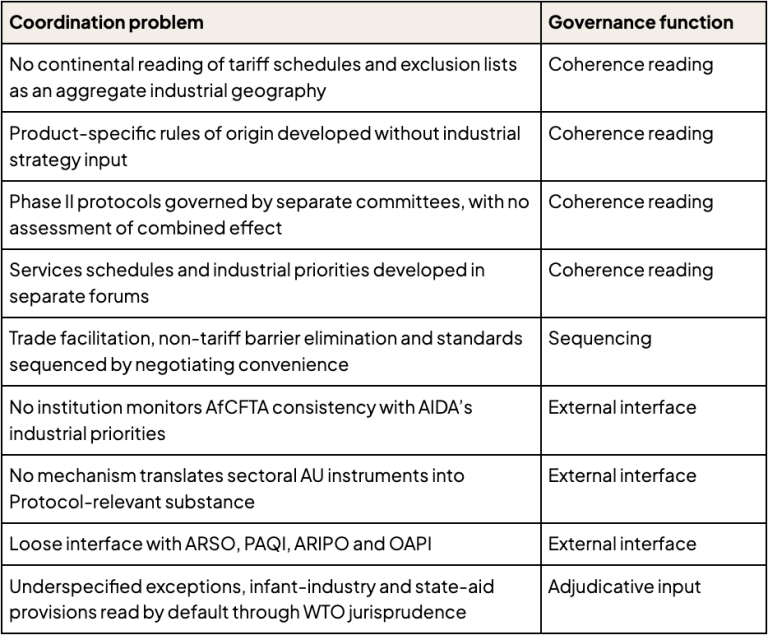
The coordination issues mentioned earlier can be addressed through four key functions that any institutional response must fulfil, regardless of which body undertakes them. These functions are:
- Coherence reading: This involves synthesising the combined industrial policy effects of tariff schedules, rules of origin, services commitments, and Phase II disciplines.
- Sequencing: This function prioritises the implementation of AfCFTA disciplines based on their critical importance for industrial development.
- External interface: This function manages the AfCFTA’s relationships with the AU instruments above it, the RECs alongside it, and third-party negotiations related to it.
- Adjudicative input: This guides dispute settlement panels to interpret general exceptions, infant-industry provisions, state aid disciplines, and performance requirements in line with the AU’s industrial policy framework rather than defaulting to WTO jurisprudence.
Table 1 outlines how these problems correspond to the functions mentioned.
Table 1: Coordination problems and the governance functions that address them
Source: Authors’ elaboration, summarising section 2 of this brief.
Several institutional options could facilitate these functions, each with its own trade-offs. Establishing a new industrial policy committee within the AfCFTA would be relatively easy, but it risks creating a silo effect and duplicating the AfCFTA Trade and Industrial Development Advisory Council, which was established in 2022. Instead, re-mandating and resourcing that Council may prove to be more efficient.
A cross-Protocol coordination mechanism could better suit the purpose at hand; however, it would require industrial policy expertise that the Secretariat would be better off drawing from the AU and the RECs rather than building from scratch. A formal joint mechanism between the Secretariat and the AU Commission’s ETTIM would directly address the AIDA gap. A stronger variant of this mechanism would empower the Commission as the political negotiator and custodian of AIDA and sectoral instruments while assigning the Secretariat the roles of implementation, monitoring, and the trade-technical interface.
Lastly, a hub-and-spoke network linking the Secretariat to AU departments, continental technical institutions, REC bodies, and partners such as the African Development Bank, UN Economic Commission for Africa, and United Nations Trade and Development would leverage existing capacities. However, networks lacking clear authority often become dominated by their strongest nodes.
Ultimately, no single option is sufficient on its own, and none of them can be fully achieved immediately.
The risks of proceeding without preparation
Without this preparatory work, several risks are predictable.
Aspirational text. The Protocol may simply restate principles already found in AIDA, Agenda 2063 and REC frameworks, without operative obligations or a mechanism to give effect to them. This is not a worst-case scenario; it is the default outcome.
Outcomes that mirror existing industrial weight. Larger economies will seek to safeguard their existing policy space, while smaller economies, which arguably need more flexibility, will struggle to defend their interests. The negotiations of the rules of origin showed the pattern, with the most diversified economies advocating thresholds aligned with their current production capabilities. Before the distinction between leading and lagging economies shapes the Protocol, agreement is needed on the metrics used to draw it.
Legal uncertainty born of speed. A Protocol concluded in haste, without the necessary mapping and governance design, would be more detrimental than no Protocol at all: it would create legal uncertainty while relieving the pressure for the harder institutional work.
Integration fatigue and a lost precedent. The Protocol will be negotiated against growing fatigue with instruments that have not delivered. If it becomes one more text that fails to make a difference, it will be very difficult to bring member states back to the table; the more likely response is a multiplication of bilateral and regional arrangements, deepening an already dense spaghetti bowl of overlapping rules.
A Protocol members cannot use. The policy space the Protocol creates will depend on the Investment, Competition and Intellectual Property protocols, none of which has entered into force. If the relationship is left implicit, a State Party that has not ratified those instruments may find itself unable to use parts of the Industrial Protocol, even after acceding to it. Practice under the other Phase II protocols suggests accession without full ratification is possible, and there is little incentive to join early when joining late costs nothing; both points warrant early clarification.
External commitments before internal agreement. Without a common internal position, member states will continue to take on industrial policy constraints in negotiations with third parties before the membership has agreed which constraints are acceptable. The risk of third parties dictating the pace of Africa’s industrial policy should not be discounted.
Conclusion
The AU Heads of State decision from February 2026 is a timely and appropriate response to a pressing set of challenges. The industrialisation gap in Africa is significant, as is the continent's struggle to implement its developmental commitments and align with the African Union's broader industrial policy framework. A genuinely impactful Industrial Policy and Development Protocol could represent one of the most consequential advances in African economic governance.
The external context adds to the urgency. Major economies are continually shaping African economies' roles in global value chains through their own industrial policies and the trade rules that accompany them. Unfortunately, this often leaves African nations positioned primarily as suppliers of raw materials and consumers of finished goods. If African countries do not act strategically and collaboratively, they risk becoming further entrenched as rule-takers in a system designed by others.
The Protocol's success will depend less on the ambition of its written provisions and more on the preparatory work leading up to the drafting. None of the choices outlined in this brief is purely technical. Each involves political choices about institutional authority, policy space and the balance between continental ambition and national sovereignty, not to mention regional and continental mandates.
Starting negotiations with clearly defined choices will yield a more effective instrument than one in which these matters are resolved ad hoc during drafting or, worse, left to dispute resolution.
Recommendations
The recommendations below are offered primarily to the drafters and negotiators, indicating where the AU Commission or State Parties would need to act. As set out above, financing and capacity-building must sit above every option as a cross-cutting commitment.
Before drafting begins
1. Table a working definition of industrial policy for adoption in the negotiating terms ofreference, based on intentionality and selectivity ratherthan the horizontal–vertical distinction, and anchored in the AfCFTA’s objectives and its principle of special and differentialtreatment.
2. Map the industrialisation-relevant provisions already in the AfCFTA. A systematic reading ofthe tariff schedules and exclusion lists, product-specific rules of origin, infant-industry and exception provisions, SEZ treatment, services commitments and Phase II disciplines would give negotiators a common baseline: a formal negotiating input showing,for each proposed provision, what already exists and what gap it would fill.
3. Establish a formal coordination mechanism between the Secretariat and the AU Commission, with defined terms ofreference and outputs ratherthan ad hoc consultations. Its mandate could explicitly include monitoring coherence between the AfCFTA and AIDA/PAIDA, a function nobody currently performs, building on the arrangement already in place for country impact assessments.
4. Commission a comparative analysis of REC industrial policy frameworks as a formal negotiating input. It would identify convergence to build on and likely political flashpoints, and test whetherthe AfCFTA’s conflict-of-laws provision (Article 19) manages conflicts with REC industrialframeworks as well as it does trade disciplines.
In the first substantive negotiating round
5. Settle the legal nature of the Protocol. Whether the Protocol creates binding obligations, or reproduces the aspirational pattern of existing instruments, is best settled early. If the answer is the latter, the case for a Protocol will be hard to argue.
6. Clarify the Protocol’s relationship with AIDA. Implementation, coexistence with defined areas of non-overlap, or a broader reading of the preservation-of-acquis provision, and record the choice deliberately in the text.
7. Settle the sequencing questions in the text rather than leaving them to later interpretation: whether the Protocol presupposes implementation ofthe Phase II protocols, accommodates phased entry or stands alone, and what differentiated entry terms, compatible with the AfCFTA’s open-membership principle, could reward members that undertake the preparatory work.
During the negotiation
8. Connect the Protocol to processes already underway. Formal links between the Protocol negotiation,the revision ofthe product-specific rules of origin and the review ofthe tariff modalities would ensure thatthe three do not proceed on separate tracks.
9. Build in support forlower-capacity members: dedicated technical supportto their delegations, decision-making rules that preventthe outcome from simply reflecting existing industrial strength, and agreement on the metrics that distinguish a leading economy before that distinction is used to shape the Protocol’s obligations.
10. Operationalise the governance network. The AU Commission,the RECs and continentaltechnical institutions,the African Organisation for Standardisation (ARSO),the Pan-African Quality Infrastructure (PAQI),the African Regional Intellectual Property Organisation (ARIPO) and the African Intellectual Property Organisation (OAPI), could be broughtinto a hub-and-spoke arrangementforthe external interface, alongside a decision on whetherto re-mandate the Trade and Industrial Development Advisory Council orto create a dedicated industrial policy body, which should draw explicitly on the outputs ofthe joint coordination mechanism.
11. Agree on the internal position before external commitments. The February 2026 decision gives the Secretariat a monitoring and reporting role on engagements with third countries;the Protocol’s shared principles would then anchorthe mandates State Parties take into third-party negotiations.
At implementation
12. Build a review mechanism into the Protocol.It could assess which ofthe four governance functions have been institutionalised,triggerthe next phase of harmonisation only once the governance foundations are in place, and let State Parties adjust provisions that do not work in practice withoutreopening the entire instrument.
Endnotes
1. Paragraph 7 of Decision on the Report of the First (1st) Meeting of the Assembly Committee of Heads of State and Government on the Implementation of the AfCFTA, Assembly/AU/Dec.975(XXXIX).
2. The EU’s Critical Raw Materials Act, for instance, caps reliance on any single third country for a strategic raw material at 65%.
3. The AU Assembly directed the phasing out of the exclusion lists, though no concrete step has been taken to do so yet (para. 16 of Decision on the Report of the First (1st) Meeting of the Assembly Committee of Heads of State and Government on the Implementation of the AfCFTA, Assembly/AU/Dec.975(XXXIX).
4. Overlapping structures include the AU Commission’s Department of Economic Development, Trade, Tourism, Industry and Minerals; the Specialised Technical Committee on Trade, Industry and Minerals; the African Union Development Agency (AUDA-NEPAD); and, within the AfCFTA, the Council of Ministers, the Committee of Senior Trade Officials and the Trade and Industrial Development Advisory Council. Overlapping instruments include Agenda 2063, Comprehensive Africa Agriculture Development Programme (2003), AIDA (2008), the Action Plan for Boosting Intra-African Trade (2012), the Africa Mining Vision (2009), the Pharmaceutical Manufacturing Plan for Africa, the AU Blue Economy Strategy (2019), the African Continental Automotive Strategy, the Single African Air Transport Market (2018) and STISA-2024, as well as the industrial policy frameworks of ECOWAS, the EAC, SADC and COMESA.
5. The developmental-asymmetry logic is expressly embedded in the AfCFTA Agreement, which lists special and differential treatment and flexibility for least-developed economies among its general principles (Article 5), and mirrors the WTO’s own special and differential treatment provisions for developing and least-developed members. See also UNCTAD (2024) on the case for sequencing productive-capacity building alongside liberalisation.
6. Assembly/AU/Dec.973(XXXIX) Page 1.
7. The provisional rules of origin for textiles and apparel (The Ministerial Directive 3/2025) were adopted by the 17th meeting of the AfCFTA Council of Ministers in October 2025, pending the finalisation of their annexes, and the 18th meeting of the Council of Ministers revised the directive and its annexes in June 2026.
8. Priority value chains have been identified by several institutions, and the lists do not fully coincide. The International Trade Centre, with the AU Commission and the European Commission, identified 94 high-potential value chains for intra-African trade, flagging pharmaceuticals, baby food, cotton clothing and automotive as especially promising (ITC, 2022). The AfCFTA Secretariat’s Private Sector Engagement Strategy prioritises agro-processing, pharmaceuticals, automotive, and transport and logistics (Erasmus, 2023). The absence of a single, agreed list is itself a symptom of the coherence and governance gap this brief describes.
Acknowledgements and references
The AfRI Practice Hub is an initiative led by ECDPM in cooperation with the Nelson Mandela School of Public Governance at the University of Cape Town. It is funded by the European Union (EU) and its member states under the Team Europe Technical Assistance Facility to Support the AfCFTA and continental economic integration (EU-TAF).

Luladay Berhanu Mengistie is a development and trade policy specialist and serves as the African Trade Competitiveness and Market Access Continental Programme Manager and AUC Liaison Advisor in the International Trade Centre's Office for Africa. Guillaume Gérout Suominen is a doctoral researcher at the University of Helsinki, in the Doctoral Programme in Political, Societal and Regional Changes, and advises, among others, the AfCFTA Secretariat, the SADC Secretariat, the AUC and UNDP on rules of origin negotiations and policy. This briefing note draws on the authors’ policy paper How to Negotiate an Industrial Policy Under AfCFTA: Architecture, Coherence, and the Governance Challenge (Policy Paper PP-24/26, Policy Center for the New South).
The authors would like to thank Bruce Byiers for his invaluable input and constructive feedback. Views expressed are those of the authors and do not necessarily represent those of ECDPM, The Nelson Mandela School of Public Governance, or the EU, including the authors’ employers. Any errors or omissions remain the responsibility of the authors. For comments and feedback, please contact bby@ecdpm.org, luladayberhanu@gmail.com or guillaume@astoveconseil.com.
A full reference list is available in the PDF version of this brief.