From transport to developmental corridors?



African trade and transport corridors are drawing high-level political attention as vehicles for regional integration, industrialisation and broader development. Living up to that promise will depend as much on the hard infrastructure as the soft angles of political coordination and industrial and trade policy implementation. Mohammed El Maziani Haddouchi and Bruce Byiers explore these ambitions and the practical challenges of realising them, and present the AfRI Practice Hub initiative.
As South African president Cyril Ramaphosa put it at the 2026 SADC summit in August:
“We need to turn routes like the Maputo, North-South, Trans-Kalahari, Beira and Lobito corridors into living arteries of commerce. We need to understand that a corridor is much more than a road or a railway line.” Though not a new call, the scale of political ambitions around African trade and transport corridors as vehicles for inclusive development is on the rise, motivated by turning ‘mere’ transport corridors into channels of economic diversification, integration and investments.
Taking over SADC’s rotating chair, Ramaphosa called on the region’s states to put in place the legal and institutional arrangements needed to develop and efficiently operate SADC’s corridors as arteries of regional integration. This matters more than ever given the growing political momentum around using the African Continental Free Trade Area (AfCFTA) to industrialise the continent through regional value chains that build on and connect firms across borders and regions.
Different corridors, different ambitions
The African continent is criss-crossed by trade and transport corridors, as our interactive map reflects, with more in development. While some, like the Abidjan-Lagos Corridor, run between coastal economies, most have historically linked hinterlands to ports, with Southern and Eastern Africa being the most densely ‘corridored’ regions.
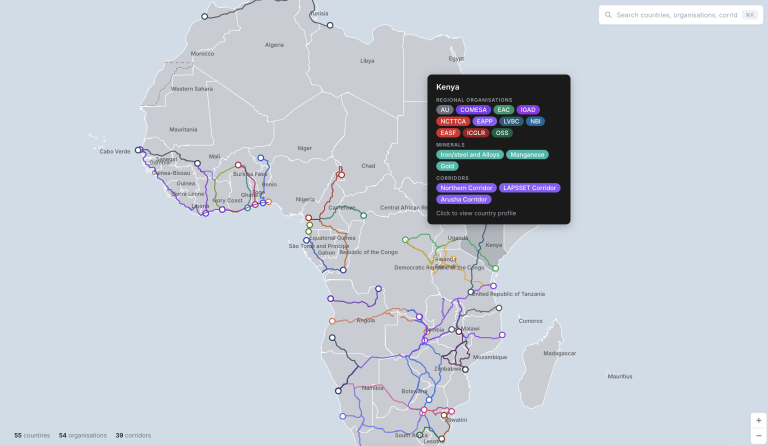
While on a map they may look the same, corridors can take many forms and reflect a range of ambitions, going well beyond a road or a railway line, as shown in the figure below.
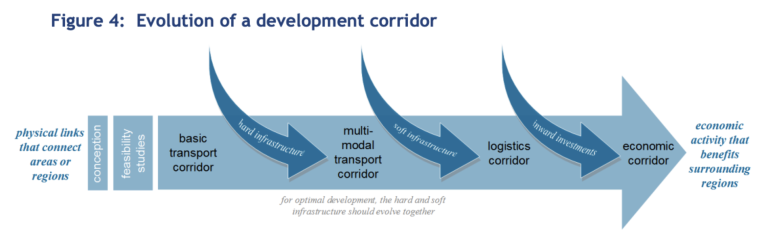
At its simplest, a ‘transport corridor’ allows goods and people to flow between two points, while a ‘multi-modal corridor’ combines several modes of transport infrastructure and links economic centres of activity. A ‘logistics corridor’, with greater regulatory harmonisation and institutional coordination, can help draw investments into manufacturing and agroprocessing activities. And with fully harmonised rules, an ‘economic corridor’ can support a wide range of economic activities, with linkages across sectors and spillovers into the sub-region.
Increasingly, a further distinction is drawn between an economic and a ‘development corridor’, with the latter supporting not only economic growth but also social development and environmental sustainability.
The Maputo Development Corridor was launched in 1996 as a “fully-fledged economic corridor” to connect South Africa’s industrial heartland to the port of Maputo. That became the blue-print for SADC’s corridor development strategy, which was later adopted at the continent level by NEPAD, the New Partnership for Africa’s Development (now AUDA-NEPAD) to address economic and spatial inequalities. Those initial experiences still form the basis for today’s approach to African corridor development.
All of these corridor pronouncements have been joined by the AU Assembly, which endorsed a ‘corridor approach’ to trade facilitation towards AfCFTA implementation. That then reflects a sense that the political momentum around the AfCFTA could drive a corridor-led industrialisation approach that combines hard infrastructure with soft reforms at the borders.
An inclusive corridor approach?
Yet, given their geography and the trade patterns of resource-rich economies, a lingering concern among policymakers, NGOs and scholars is that corridors risk being primarily ‘extraction corridors’: channels for exporting raw materials with minimal local value added, while importing manufactured and processed goods. This scepticism is particularly pronounced on corridor developments linked to critical minerals, such as the rehabilitation of the Lobito Corridor.
To address this, programmes such as the AU’s Programme for Infrastructure Development (PIDA-PAP 2) take an ‘integrated corridor approach’ that seeks to be employment-oriented, gender-sensitive and climate-friendly, connecting urban and industrial hubs with rural areas. In a similar way, the AfCFTA Women and Youth Protocol seeks to support the participation of women and youth in intra-African trade along corridors and regional value chains.
In this vein, SADC members committed to transforming the North-South Corridor from a transit and trade corridor into a smart and integrated economic corridor, citing the potential to generate $16 billion in GDP and 1.6 million jobs across the region, while integrating young people, women and small and medium enterprises. The EU’s Global Gateway ‘strategic corridors’ approach similarly seeks to complement these African efforts by supporting public and private investments as well as policy and regulatory harmonisation along 12 key corridors.
The ambitions attached to corridors therefore continue to grow. But these broadening ambitions raise questions about what policymakers need to do in practice to attract corridor investments, while at the same time support job creation in local communities, protect and support small-scale traders, and develop regional value chains.
A reality check? Political incentives and competition
Infrastructure gaps remain a real obstacle to the functioning of regional corridors and regional trade. However, the low rates of intra-African trade (around 16%) cannot be explained by hard infrastructure alone. The record of regional integration illustrates the persistence of (non-)tariff barriers, complex administrative procedures, poor implementation of regional agreements, weak customs cooperation and institutional coordination gaps. Though well-known, resolving these issues remains a prerequisite for the AfCFTA’s ambitions to support industrialisation and value-addition through the development of regional value chains.
Fundamentally, these challenges are not only technical, but also political. The limited diversification of African economies has historically resulted in economically distant neighbouring countries that produce similar goods and compete for the same markets. Institutional coordination and planning, and implementing simple and harmonised regulations all affect the interests and incentives of key actors within and between states.
Within states, short-term risks or fears of economic (and revenue) disruptions have disincentivised governments from liberalising intra-regional trade. Between countries, coastal countries compete to incentivise the use of their ports and corridors, while landlocked countries seek to diversify their access to the sea. For instance, in West Africa, where the potential of the Abidjan-Lagos Corridor has gained popularity among policymakers and international partners, neighbouring coastal states are revamping their port infrastructure and competing for cargo as a gateway to the Sahelian hinterland, often at the expense of west-east regional connectivity.
Yet, there has been significant progress in regional market integration, as one-stop border posts are increasingly operationalised and procedures increasingly digitalised. Corridor competition can also encourage greater investments and development.
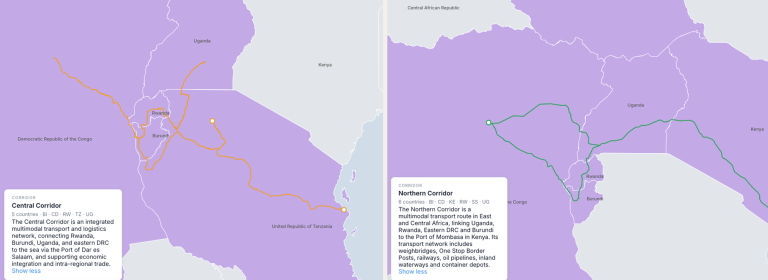
For example, in East Africa, the Dar es Salaam and Mombasa ports dominate trade flows in and out of the region, with infrastructure developments in one corridor often triggering improvements in the other, such as dry ports, container capacity and highways to remain competitive and attract usage. Both these corridors are administered by corridor authorities, the NCTTCA and CCTTFA, mandated to facilitate trade, support socio-economic development and attract investments along the corridor to accelerate sustainable growth – while new corridor authorities are emerging on the Abidjan-Lagos and Lobito corridors.
Though such developments should not obscure the persistence of (non-)tariff barriers and lengthy and costly procedures at many corridor borders, they point to ways in which further policy reforms could help stimulate economic and developmental corridors.
The AfRI Practice Hub
The AfRI Practice Hub – an initiative by ECDPM and researchers from The Nelson Mandela School of Public Governance – will inform and support this debate on how to realise inclusive industrial development ambitions through African corridors. Just some of the key issues to look at include how to facilitate inclusive trade and integrate informal and small-scale traders through digitalisation, the lessons to be drawn from existing corridor authorities, and the implications of the growing trend towards private sector border management.
Ultimately, whether corridors become arteries of regional integration and inclusive development under the AfCFTA or remain ‘mere’ transport routes will depend not only on the hard infrastructure and harmonised regulations that let trade flow, but on whether member states can coordinate their industrial and trade-related policies to support inclusive growth and the development of regional value chains.
Mohammed El Maziani Haddouchi is a research assistant working on African economic integration at ECDPM. Bruce Byiers is associate director of sustainable and inclusive economic development at ECDPM.
The AfRI Practice Hub is an initiative by ECDPM with researchers from The Nelson Mandela School of Public Governance at the University of Cape Town. It is funded by the European Union under the Team Europe Technical Assistance Facility to Support the AfCFTA and Continental Economic Integration (EU-TAF).
Views and opinions expressed are those of the authors and do not necessarily reflect those of ECDPM, The Nelson Mandela School of Public Governance or the European Union.