Harnessing the AfCFTA as one among multiple memberships


The African Continental Free Trade Area (AfCFTA) is increasingly seen as the policy framework for African economic transformation. At least among continental policymakers. But from a country perspective, it is only one of many regional frameworks through which national priorities and growth strategies can be pursued. Bruce Byiers, Philomena Apiko and Mohammed El Maziani Haddouchi explore the political and practical dimensions of multiple regional memberships and what that means for the AfCFTA.
The AfCFTA builds on and connects the free trade areas and customs unions of the African Union (AU)’s recognised regional economic communities (RECs), along with “other regional trade arrangements”. How these arrangements relate to one another therefore matters as much as their number.
At the AU’s coordination meeting of 4 October 2026, AU Commission chairperson Mahmoud Ali Youssouf cited the AfCFTA as a key driver of economic integration and sustainable development. He also emphasised the importance of a clear and effective division of labour between the AU, the RECs and regional mechanisms, to avoid duplication and ensure greater coherence in implementing continental priorities. This is a longstanding agenda, but one that remains somewhat intractable given underlying interests and incentives in regional cooperation and the different organisations set up to govern it.
Why countries collect memberships
Our map of regional memberships shows 54 regional organisations through which governments collaborate on a diverse range of themes. Söderbaum and Stapel count 156 regional organisations when task-specific organisations and specialised agencies are included. The well-known ‘spaghetti bowl’ of regional economic communities therefore sits within a much denser network of overlapping memberships, where mandates and issues inevitably intersect. For instance, the Democratic Republic of the Congo (DRC) belongs to at least 21 regional organisations, while Mauritius belongs to as few as five.
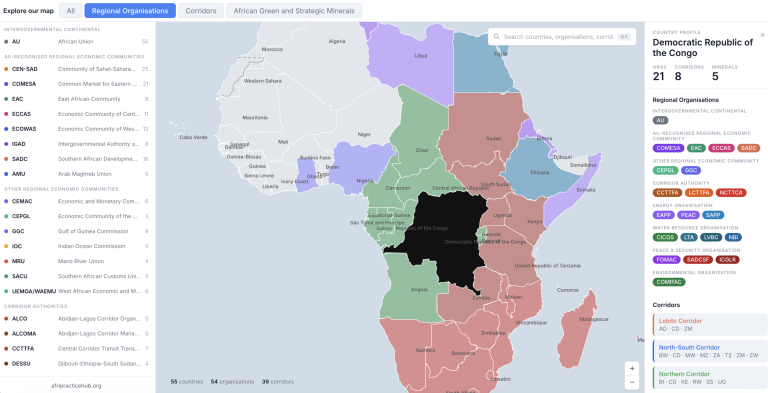
Countries use different memberships for different things. When the DRC joined the East African Community (EAC) in 2023, it did so for both economic and security reasons: the country connects Central, Eastern and Southern Africa, and has a stake in regional agendas covering trade, minerals, energy, water and security. It did not give up its other memberships, as each serves as a platform for negotiation and a route to pursue different interests.
Countries also use their memberships selectively. Kenya used the free trade area rules of the Common Market for Eastern and Southern Africa (COMESA) to protect itself from perceived sugar dumping by Uganda, despite both being in the EAC customs area. In West Africa, the West African Economic and Monetary Union (UEMOA) serves a different economic and political purpose for each of its members. Togo, for instance, has rolled out a digitised UEMOA certificate of origin for export, even if in theory, all trade rules and processes of UEMOA and the Economic Community of West African States (ECOWAS) have been harmonised.
This reflects Thandika Mkandawire’s point that regional integration is a political project, which only makes sense to member states if it serves their national ambitions, but also reflects different identities. Advancing integration requires an honest acknowledgement of interests, the costs and benefits of integrating, the relation between national policies and regional ambitions, and of the fact that there are winners and losers. Regional organisations are then tasked with reconciling those interests with pan-African projects and each other.
It has long been argued that belonging to several regional organisations may maximise the benefits of integration and minimise the losses by spreading risks, particularly for weaker economies. However, there are also risks. They can create policy and regulatory inconsistencies and inefficiencies, duplicate or contradict activities, blur lines of authority and impose heavy management and financial burdens on member states. All this undermines the regional economic communities’ role as pillars of the African Economic Community. Such concerns drove past efforts to ‘rationalise the RECs’ and have been partly reignited by Article 3 of the AfCFTA Agreement, which lists as one of its objectives “to resolve the challenges of multiple and overlapping memberships”.
Multiple memberships have financial consequences. ECOWAS and UEMOA fund a large share of their budgets through community levies of 0.5% and 0.8% on imports, respectively. Other regional organisations rely heavily on external partners: for the EAC, the 2025-26 budget was 67% externally financed, and at least 58% of the African Union’s funding in 2024 came from developmental partners. Staffing is also thin: a 2025 UNECA report notes that trade and customs directorates at the AU Commission and the RECs generally have fewer than 20 staff members each.
Firms in countries belonging to several regional economic communities face administrative burdens in navigating diverse and at times conflicting trade regimes, rules of origin and customs procedures. This prolongs customs clearance and undermines trade corridors within and between regional blocs. Some general coordination platforms exist, such as the Inter-regional Knowledge Exchange Platform and the Inter-regional Coordination Centre, but effective inter-REC coordination on trade would require practical alignment to harmonise policies, removal of non-tariff barriers and lower compliance costs.
Memberships have not remained static either. For instance, COMESA, EAC and SADC have all expanded in the last ten years, while ECOWAS has lost three of its members to the newly formed Alliance of Sahelian States although these remain UEMOA members.
The AfCFTA as one among many
In addition to what the regional economic communities have achieved in trade-related areas, the AfCFTA introduces its own set of trade rules. Article 5 of the AfCFTA Agreement talks about RECs as “building blocks” and the “preservation of the acquis”, while Article 19 ensures that RECs’ trade-related arrangements remain where these go further than the AfCFTA.
How the continental and regional levels relate therefore varies by topic or area. In our analysis of the eight protocols underpinning the AfCFTA, we identify seven types of regional-continental relations that are mentioned, ranging from information sharing to harmonisation, to facilitate cooperation through different forms.
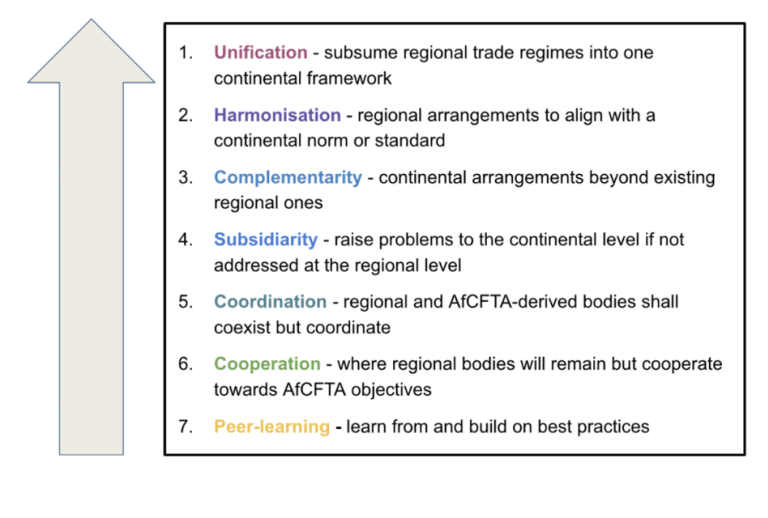
Seen this way, the AfCFTA is best understood not as a way of supplanting or unifying other regional organisations, but as a continental framework whose objectives are achieved through and across these existing structures. Both the AfCFTA and the RECs increasingly recognise the need to cooperate for a common integration agenda. COMESA, for instance, has developed its own AfCFTA strategy, highlighting where the AfCFTA can draw on its tools and vice versa.
Ways forward
With a constantly shifting set of regional organisations, whose ever-expanding agendas respond to shifting national interests, there are no simple solutions. The old idea of ‘rationalisation’ and ‘harmonisation’ is unrealistic and understates the political legitimacy of all these organisations.
Seen positively, this range of organisations offers different ways to advance AfCFTA-regional collaboration through ‘flexible geometry’, advancing collaboration without being held back by the reticence of some. In this vein, the AfCFTA Secretariat is reportedly embarking on an exercise to see where and how AfCFTA and REC agendas overlap, which should help identify synergies with what is already taking place regionally.
The mechanisms to cooperate exist. The challenge is to identify where there may be real political traction for national-level economic change through the different regional and continental mechanisms available.
These are all crucial issues that we plan to explore through the AfRI Practice Hub in the following months:
-
How can AfCFTA Secretariat-REC and AU-REC coordination meetings be better used around some of the areas with potential for flexible geometry?
-
How can REC and wider regional organisation instruments and experience, for example in cross-border payment systems or non-tariff barrier reporting mechanisms, support AfCFTA implementation and vice versa?
-
What lessons can be drawn from existing corridor authorities and their interactions with regional organisations to boost continental trade?
Related to this, the Nelson Mandela School of Public Governance offers training to the RECs and AfCFTA Secretariat to support regional and continental coordination. This combines leadership development and practical implementation approaches to work with regional and national institutions, including AfCFTA National Implementation Committees and regional value chains.
This may help overcome some of the coordination challenges discussed above. Ultimately, the RECs and AfCFTA all seek the same goal of promoting economic transformation through market integration.
Bruce Byiers is associate director of sustainable and inclusive economic development at ECDPM. Philomena Apiko is a policy analyst working on economic transformation and African economic integration at ECDPM. Mohammed El Maziani Haddouchi is a research assistant working on African economic integration at ECDPM.
The AfRI Practice Hub is an initiative by ECDPM with researchers from The Nelson Mandela School of Public Governance at the University of Cape Town. It is funded by the European Union under the Team Europe Technical Assistance Facility to Support the AfCFTA and Continental Economic Integration (EU-TAF).

Views and opinions expressed are those of the authors and do not necessarily reflect those of ECDPM, The Nelson Mandela School of Public Governance or the European Union.